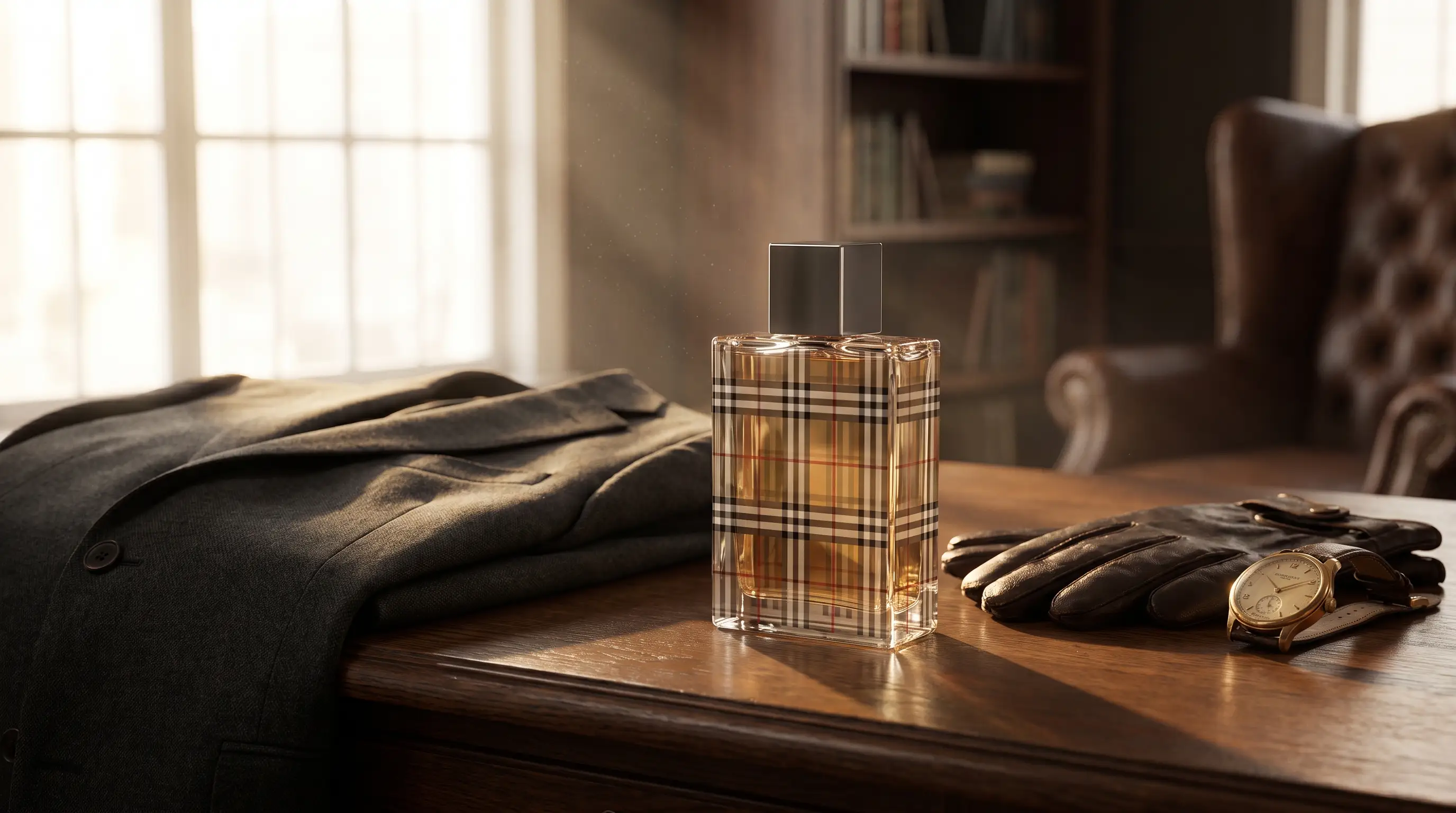
There is a category of fragrance you do not choose. It chooses you — usually by accident, on the edge of someone else's bathroom shelf, half-empty, the gold cap slightly dulled by years of careless hands. That is how most men come to know Burberry for Men. Nobody walks into a perfumery in Riyadh or London and asks for it by name as their first bottle. It arrives later, borrowed, inherited, or discovered in a drawer that once belonged to a father or an uncle who never once explained why he wore it. And then, years on, you understand.
Composed in 1995 by Michel Almairac, Burberry for Men was born into a very particular moment — a decade still devoted to the aromatic fougère, that formal, herbal architecture of lavender, moss, and amber that ruled every barbershop mirror and boardroom handshake for two full decades before it. Burberry did not attempt to reinvent that grammar. It simply spoke it more quietly than anyone else. Mint, lavender, thyme, and bergamot open the composition like the first cold air of a Gulf winter morning — brief, bracing, gone before you can hold onto it. Then comes the heart: moss, geranium, jasmine, sandalwood, unfolding with the patience of a man who has nowhere urgent to be. The base — musk, vanilla, amber — is where the fragrance finally reveals its true temperament: warm, settled, entirely unconcerned with being noticed.
A Dynasty, Not a Formula
Spend time inside fragrance circles — the kind of gatherings where men trade vintage batches the way others trade watches — and you will notice something particular about how this genre is discussed. Nobody talks about the aromatic fougère the way they talk about a niche release or a celebrity cologne, chasing the newest name. They talk about it the way one speaks of an old record collection: reverently, a little defensively, always comparing which pressing, which year, which formula held its nerve before reformulation quietly stole something from it.
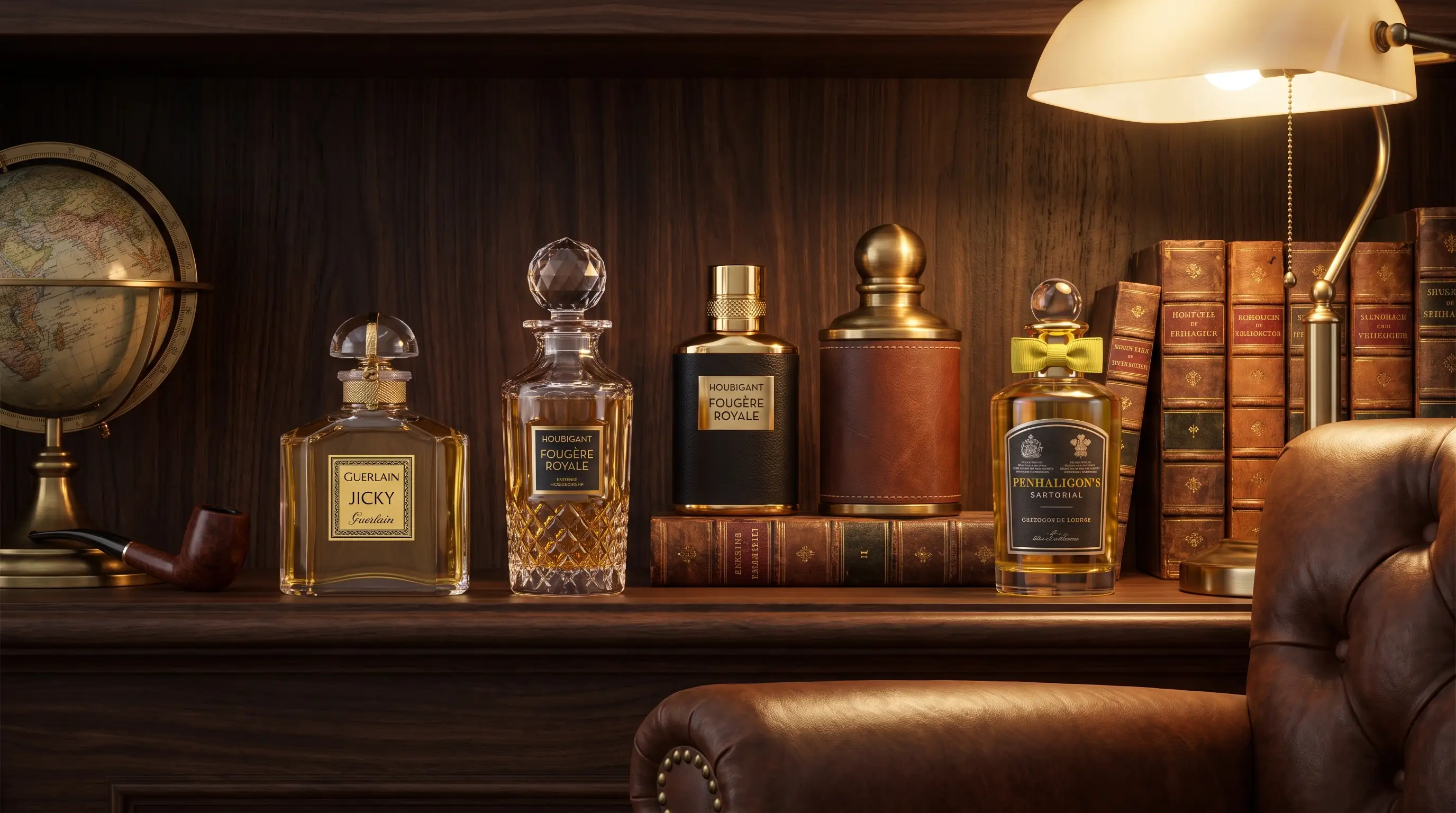
Burberry sits inside a very specific circle of that dynasty — five names that keep resurfacing in the same breath.
Davidoff Cool Water — The Sea That Walked Into the Room
Priced between $25 and $45 for 125ml, Cool Water opened in 1988 with mint, lavender, sea water, and coriander, before drifting into sandalwood, jasmine, and geranium, then settling into musk, oakmoss, cedar, amber, and tobacco. Where Burberry stays dry, almost austere, Cool Water introduced the ocean itself into masculine perfumery — an opening so recognisable it eventually outgrew its own originality, copied into a decade of drugstore body sprays until an entire generation could no longer separate the original from its imitators.
Azzaro Pour Homme — The Elder Statesman
At $20 to $35 for 100ml, this 1978 composition is still spoken of by collectors with something close to reverence. Lavender, anise, bergamot, and basil open into sandalwood, patchouli, cedar, and cardamom, before oakmoss, leather, amber, and tonka bean close the story. More resinous and anise-forward than Burberry, it shares the same bloodline — though almost every admirer today adds a quiet caveat: the modern formulation fades within the hour, a beauty that now demands frequent reapplication to hold its shape.
Paco Rabanne Pour Homme — The Green Elegance
Between $30 and $45 for 100ml, this 1973 classic opens with rosemary, clary sage, and Brazilian rosewood, moving through lavender, geranium, and tonka bean, before resting on oakmoss, honey, musk, and amber. Often called Azzaro's closest sibling, it carries a touch more sweetness and green vitality — pine forests and leather gloves, as devotees describe it — though it, too, rarely survives past the second hour in its current form.
Drakkar Noir — The One Who Announces Himself
At $15 to $30 for 100ml, Drakkar Noir remains the loudest voice in this family — rosemary, artemisia, and lavender over oakmoss and spice, resting finally on musk and amber. Where Burberry is the quiet gentleman waiting his turn to speak, Drakkar Noir is the one who has already entered the room before anyone noticed the door open. Built loud enough in 1982 that even a softened modern batch still carries real presence.
Davidoff Cool Water Intense — Where the Lineage Landed
At $35 to $45 for 125ml, this newer expression — green mandarin, coconut nectar, and amber — shows precisely where this fougère bloodline eventually arrived: softened, sweetened, folded into the gourmand-amber language that a newer generation of noses now prefers. Worth knowing not as a rival, but as a mirror of how far the family has travelled from its own origins.
What the Reformulation Years Taught This Whole Family
Every name on this list carries its own story of compromise. Cool Water divides opinion cleanly in half — one side still smells a crisp, honest classic; the other cannot separate it from a decade of imitators that borrowed its DNA and flooded it into every gym locker room on earth. Azzaro and Paco Rabanne both ask the same quiet sacrifice of their admirers: love us, but reapply us more than you'd like. Drakkar Noir, alone among them, seems untouched by the erosion — built with enough original force that even time has struggled to soften it.
Burberry, by comparison, rarely enters these debates with any real heat. It is not a fragrance people defend in forum threads at midnight. It is a fragrance people simply keep — in a drawer, on a shelf, in a coat pocket — for years, without ever needing to explain themselves to anyone.
What It Costs to Own a Piece of This Quiet Elegance
Part of Burberry for Men's enduring charm is that it never demanded the price of admission its heritage might suggest. It has always lived in that rare, generous space where English tailoring meets the everyday man's budget — and market prices, gathered across the fragrance world's major retail corners, reflect exactly that.
Region | Typical Price (100ml EDT) | Where It's Commonly Found |
|---|---|---|
United States | $25–$45 | Discount fragrance retailers such as FragranceX, FragranceNet, and Jomashop; occasionally lower during seasonal sales |
United Kingdom | £25–£45 | Amazon UK, PriceRunner-listed retailers, and select department store counters |
Canada | CAD $45–$65 | Major pharmacy chains, duty-free counters, and online fragrance discounters |
These figures move with the season and the retailer, as they always do for a fragrance this widely distributed — but the underlying truth stays constant. This is a scent priced for the wardrobe, not the vault, which has always been part of its quiet dignity.
Who Should Actually Wear Burberry for Men
Not every fragrance needs a grand audience, and Burberry for Men has never asked for one. It belongs, first and foremost, to the man who values consistency over spectacle — the one who wants a fragrance that behaves the same way every morning, regardless of the room he is about to enter.
It suits the professional who needs a scent that reads as composed rather than assertive — appropriate for a boardroom in London as easily as a majlis gathering in the Gulf, where restraint is its own form of respect. It suits the man building his first serious fragrance wardrobe, who wants a genuinely well-mannered classic before reaching for anything louder or more expensive. And it suits the collector of vintage masculines, who understands that some of perfumery's most honest achievements were never the loudest in the room — only the most enduring.
It is, in short, a fragrance for the man who has already learned that true elegance rarely needs to explain itself.
The Closing Thought
Every fragrance in this lineage has, at some point, had to prove itself louder than the last reformulation took from it. Burberry never had to. It never asked for anyone's attention in the first place — which may be exactly why, three decades later, it has never had anything to lose.